

New Partnerships and Programs Advance the Gabelli School’s Strategic Plan
“We are following through on the bold plans that we have collectively created. It is gratifying to see faculty members and administrators coming together to execute their parts of the plan and deliver meaningful results,” said Lerzan Aksoy, Ph.D., dean, George N. Jean Ph.D. chair, and professor of marketing at the Gabelli School. “We will continue to build upon this early success, accelerating strategic initiatives to ensure that the Gabelli School remains well positioned to serve our students, to make a difference in local and global communities, and to thrive in the business education marketplace.”
RECENT HIGHLIGHTS
New Board Fellows and Entrepreneurship Outreach Programs Poised to Expand Local and Global Impact
The Fordham Board Fellows Program will launch this fall, placing Gabelli School graduate students as ex-officio members on local nonprofit boards. They will provide participating nonprofits with fresh perspectives and help these organizations to advance their strategic priorities.
Dennis Hanno, Ph.D., an associate clinical professor in the Leading People and Organizations Area and co-lead of the Local Partnerships and Impact Project Team, believes that the program will enable Gabelli School students to make a significant impact in local communities. “These board fellows will have a place at the table with the leaders of these organizations,” he noted. “They will function as real board members who can truly influence the direction of an organization.”
Francis Petit, Ed.D., associate dean for global initiatives and partnerships and co-lead of the Local Partnerships and Impact Project Team, sees the program as a win for all involved. “It’s definitely a wonderful learning experience for our students, but it also certainly benefits our nonprofit partners,” he said. “Some boards aren’t as active as they should be. In nonprofits, there’s a lot of putting out fires, which can derail the strategy. Hopefully the board fellows will help the nonprofits to remain focused in terms of moving forward with the strategic projects they take on.”
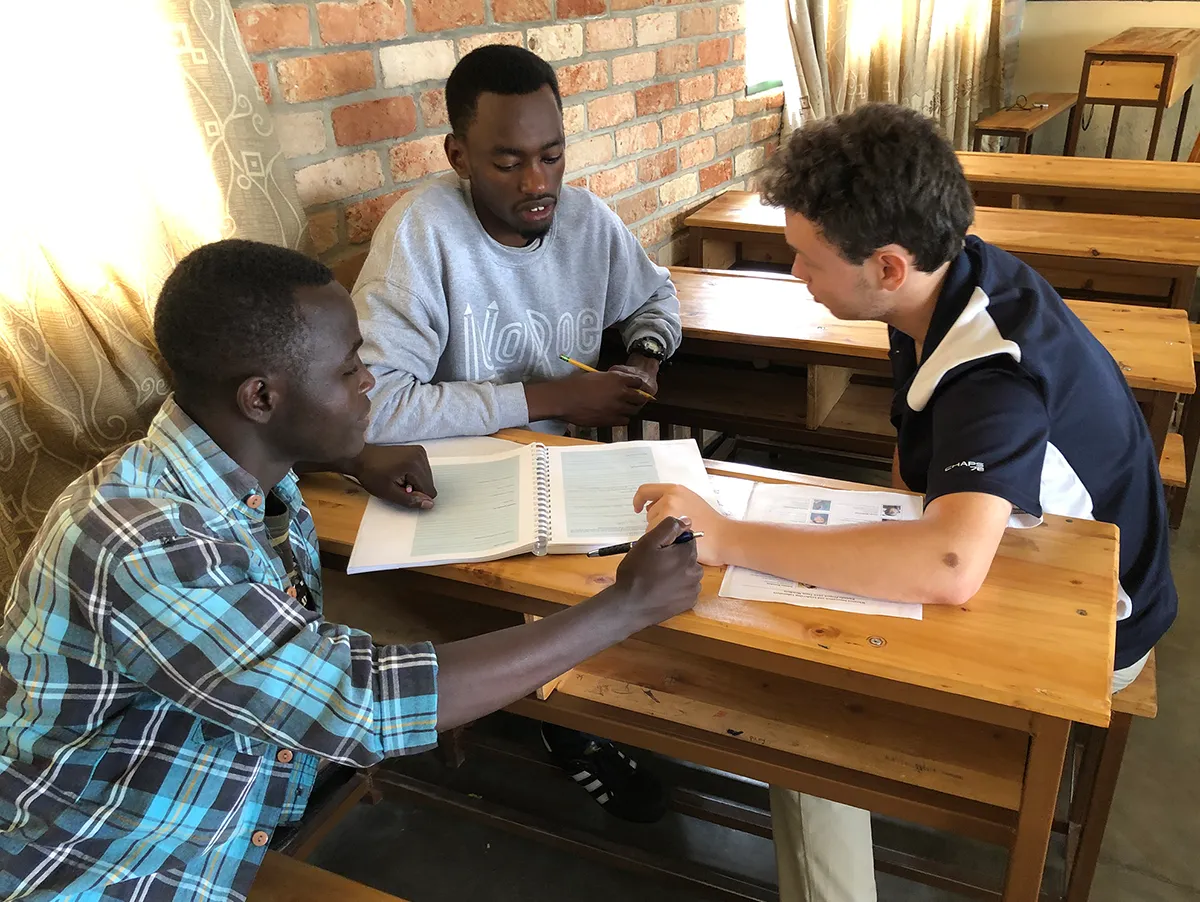
Outside of the U.S., during the 2026 spring semester, Gabelli School undergraduate students, as well as those from other Fordham programs, will travel to Rwanda to teach high school students about entrepreneurship through the new ¡GO! Rwanda program, which will be offered in partnership with the Benebikira Sisters, a Rwandan Jesuit order. They will live and work at Maranyundo Girls School, delivering the Fordham Youth Impact Program to the local students. The curriculum, which was piloted in the Bronx last year, is designed to teach young people how to develop immediately actionable solutions for problems they see in their communities.
“In Rwanda, our students will see how much people value an entrepreneurial mindset, how much it brightens their whole world by empowering them,” Hanno said, noting that they intend to replicate the program in other communities, locally and globally.
According to Petit, the ¡GO! Rwanda program dovetails with the Gabelli School’s commitment to providing students with opportunities for international experiences. “Part of the Gabelli School’s mission is to develop global, compassionate leaders, and this certainly satisfies that goal,” he concluded.
Nurturing Professional Development and Wellness for Staff Members and Administrators
In May 2025, the project team arranged one-on-one, personalized leadership coaching for Gabelli School administrators. Twelve staff members were offered the opportunity to receive two 45-minute coaching sessions per month for three months.
According to Beth Moore, senior director of operations at the Gabelli School and co-lead of the project team, the coaching opportunity generated a lot of interest. “I think employees realized the tremendous value this coaching opportunity presented,” Moore shared. “Many expressed they had not had this type of self-development opportunity before.”
“The coach created the space for me to thoughtfully explore and articulate my goals and strengths, while guiding me through real-time moments of professional growth,” commented Marisa Villani, Ph.D., senior assistant dean for undergraduate studies. “The insights I gained have had a lasting impact—I can see a meaningful shift in how I lead and engage with others.”
Jeffrey Haynes, senior director of information technology at the Gabelli School and co-lead of the project team, noted that staff development initiatives are generally less common than support for faculty development and research. “The ability to offer something like this to administrators really helps with engagement and hopefully adds to their satisfaction in being a part of the Gabelli School of Business family,” Haynes said.
It’s critical that administrators update their skills and stay abreast of the latest advances in their respective fields for their own benefit and for the good of the institution. “I think it’s extremely important to invest in your staff and make them feel valued,” Moore said.
To help facilitate external professional development experiences, a new portal for funding requests will go live this fall. “Some people don’t know if they can or should be requesting to go to a conference. And supervisors may not know if there’s budget to cover such requests,” Haynes explained. “This formalizes the process, making it easier for anyone to apply and for managers to review and approve requests.”
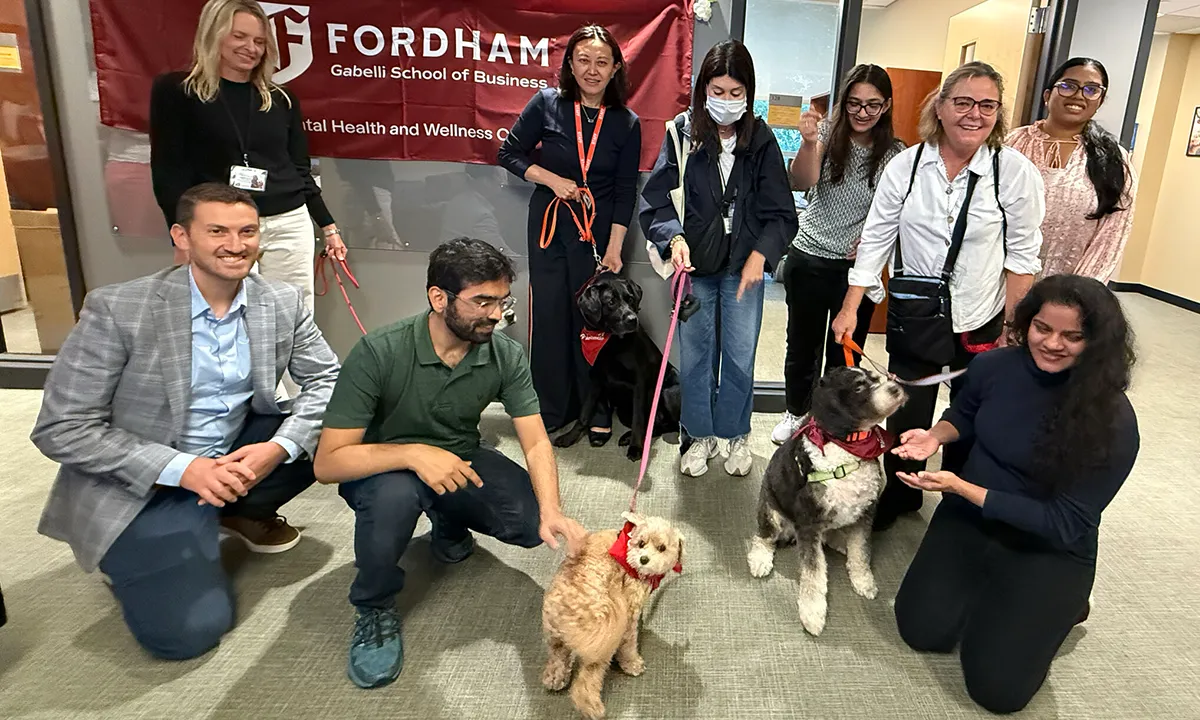
Stress reduction is also a priority for staff, administrators, faculty members, and students. Recently all were treated to a visit from trained therapy dogs at an event organized by the Fordham Mental Health and Wellness Club. The Club partnered with New York Therapy Animals, Inc.—a nonprofit that specializes in delivering therapeutic animal programs to schools, heath care facilities, and libraries—to bring a therapy dog team to the Gabelli School’s Student Success Center. The visit offered a welcome break from the demands of the new semester, enabling everyone to take time out to de-stress, connect with other members of the campus community, and nurture their emotional well-being.
Providing Guidance and a Greater Sense of Community for Faculty Members
The new orientation standardizes processes to ensure that all area chairs have the same foundation. “In my 10 years working with area chairs, we’ve never had something like this,” said Josefina Kocovic, director of faculty administrative support. “It serves as a guide to help keep everyone on point.”
Brent Horton, chair of the Law and Ethics Area, sees value in the sessions, not only as opportunities to learn the “nuts and bolts” of the area chair role, but also as open forums that foster collaborative problem-solving. “We were able to talk back and forth about the different pain points we experience and say, ‘Are there ways that we can improve this in the future to make it run better?’” he recalled.
The project team also recently launched a series of faculty lunches, providing faculty members with the opportunity to build relationships with each other outside of conventional work situations. The idea was developed in response to faculty members expressing a desire for increased connection with their colleagues.
Haynes sees a new energy at the School as different elements of the Strategic Plan are coming to fruition. “There’s an increased level of positivity among the administrators and faculty,” he observed. “They are seeing things actually happening—they’re seeing their ideas take shape, and it’s making a big difference.”

New Leadership for New Partnership Models
“Whether we’re building on existing partnerships or identifying new partners, we have to figure out how we might work together in a way that is synergistic, where there’s an ROI for both of us,” he said. “Really understanding what our partners are looking for, what the broader industry needs, as well as emerging trends—that’s priority one.”
Montejo believes the Gabelli School offers partners a unique value proposition that encompasses deep subject matter expertise, prime locations, and ideals that are inherently ingrained within Fordham’s Jesuit tradition. “We wear our focus on ethics, values, and responsibility on our sleeves in a way that other institutions don’t,” he noted. “I think that many potential partners are really responding to that at this moment.”
Montejo, who joined the Gabelli School this past May, brings a wealth of experience to his role. He previously served as vice president of innovation industries at the New York City Economic Development Corporation (NYCEDC), leading efforts to support tech startups, build a coalition of venture firms, and launch the NYC VC Internship Program. Prior to his time at NYCEDC, he was a senior officer at Solve, a social impact incubator at the Massachusetts Institute of Technology (MIT) that accelerates solutions through open innovation and partnerships.
Montejo has pinpointed several areas that are ripe for partnership cultivation. “There are considerable opportunities in executive education to build up our engagements with companies across industries that could really benefit from the incredible expertise that exists at the Gabelli School,” he asserted. He also sees potential in the public sector, noting that Fordham’s presence across the Bronx, Manhattan, and Westchester is a draw for government partners. “Spreading economic activity and opportunity across New York is a big priority for the city and state, and I think Fordham is uniquely positioned to help make that happen,” he explained.
Another goal for Montejo is to build partnerships that expand career opportunities for Gabelli School students. “We’re really thinking about the companies that are leading in job creation, and we’re working to make those strategic connections,” he said. In early steps toward new collaborations, Montejo has initiated discussions with organizations such as the Partnership Fund for NYC, Turner MIINT, MLT, and the Founder Institute.
Montejo sees great pride and promise in the Fordham community. “There are so many double and triple Rams. People double down on Fordham, and I think that is a great testament to the University’s impact,” he said. “And there’s an opportunity to make them quadruple Rams through partnerships!”