

News
Gabelli School Marketing Area and IAA North America Host
“Navigating the Tightrope: Marketing in a Polarized World”
The research portion of the event, based upon a study conducted by Nejad; Genevieve O’Connor, Ph.D., associate professor of marketing; and Aniko Nakazawa DeLaney, lecturer of marketing, focused on findings regarding three key areas—Social vs. Political Issues, Authenticity & Transparency, and Beyond Algorithms: Real Talk Wins, and compared the sentiments of Boomers, GenX, Millennials, and GenZ. The research was conducted among 23 chief marketing officers via in-depth interviews and 950 individuals via survey. Survey participants were polled on questions including: Do brands have a responsibility to take a stance on social issues? Do brands have a responsibility to take a stance on political issues? Do brands need to be authentic? Do brands need to be transparent? How would you react to content from a brand that conflicts with your personal values?
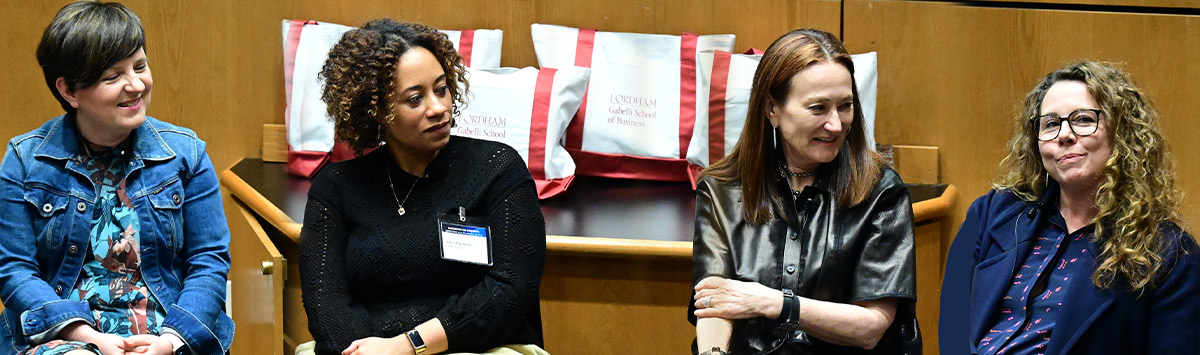
Panel discussion participants Magdalena Pawelec, senior director, head of brand marketing, Whirlpool Corporation; Isys Caffey, president and head of strategic communications and reputation management, Stripe Theory; Carol Schuster, president of IAA North America and CMO, Lafayette 148; and Amy Weisenbach, chief marketing officer, The New York Times.
The evening concluded with a panel discussion featuring Magdalena Pawelec, senior director, head of brand marketing, Whirlpool Corporation; Schuster; Amy Weisenbach, chief marketing officer, The New York Times; and Isys Caffey, president and head of strategic communications and reputation management, Stripe Theory. Each panelist provided an insider’s view of the ways in which her company is dealing with a changing marketplace, deep shifts in the sociopolitical landscape, and a new generation of consumers who want their voices heard.
“Events of this caliber allow us to share the research we are conducting with broader audiences, while providing an opportunity for the same groups to hear from top industry experts who often help to validate our findings and provide greater context,” noted Nejad. “They provide a forum for important discussions that build thought leadership for the Marketing Area and the Gabelli School, while exploring critical industry issues and bridging the gap between industry and academia. We welcome brands and companies to connect with us, continue the conversation, and explore opportunities and challenges together.”