

CIO Roundtable Convenes Top Thought Leaders to Discuss Revolutionary Changes Occurring in Technology
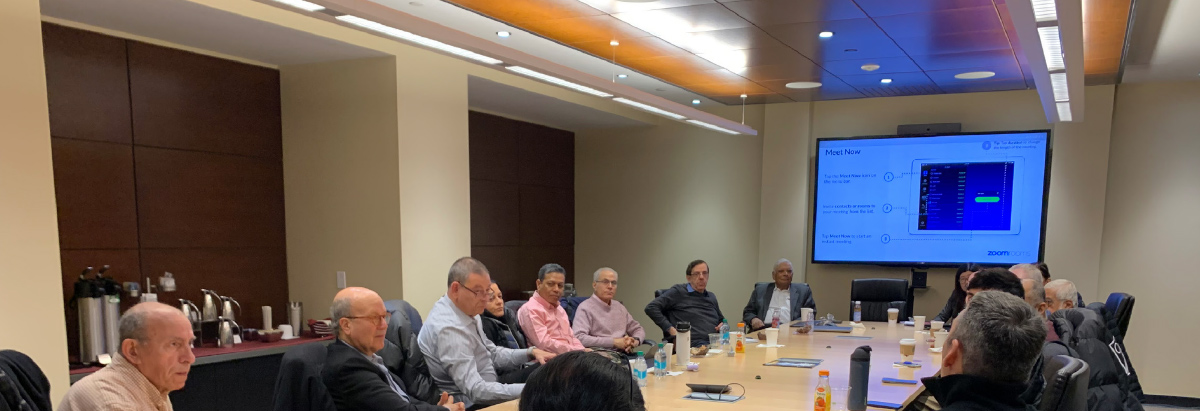
“The CIO Roundtable affords a setting in which those who are deeply involved in critical facets of technology as it relates to business, can together explore the rapidly evolving tech environment, deliberating the progress being made while understanding the social and ethical implications that come with it,” commented Saharia. “This year’s discussions have been particularly exciting as changes are happening in real time due to the lightning speed at which artificial intelligence is infiltrating everything we do. It is our goal to surface both the opportunities and obstacles that are arising and to provide the knowledge to take advantage of or to address them head on, while stimulating dialog that can lead to new breakthroughs.”
Examples of Recent Discussions
Jim McCormack, EVP, chief technology officer, Farm Credit Financial Partners and a graduate of the Gabelli School’s Executive MBA program, discussed the ways in which shadow AI is occurring in companies and how they are developing new policies to address the situation, balancing innovation vs. control in a regulated environment.
Cherif Amirat, PhD, retired CIO, IEEE, and currently a clinical faculty member at Stevens Institute of Technology, reviewed technology predictions from organizations, including McKinsey, Goldman Sachs, and IEEE, indicating that several AI technologies, such as content generation, AI-enabled edge devices, and personalized computing, are being commercialized very quickly. Areas where the future impact of AI is expected to be significant include: health care, engineered therapeutics, and embodied physical AI (robotics).
Michael Michelini, senior vice president of enterprise technology and corporate services at Cadent, an AI-powered predictive advertising platform, discussed how industry executives could cut through the hype of AI and instead look at measurable outcomes across employee productivity, engineering acceleration, and product innovation.
Tsvi Gal, chief technology officer and head of enterprise technology services at Memorial Sloan Kettering Cancer Center, focused his talk on the groundbreaking advances that are being made in the diagnoses and treatment of cancer as the result of the use of AI as an analytical tool in health care.