







Leadership and Management:
Accelerating Workforce Transformation
Through Technology and the Human Edge
Through Technology and the Human Edge

Leadership and Management:
Accelerating Workforce Transformation
Through Technology and the Human Edge
Through Technology and the Human Edge
In this edition, we also highlight the achievements of the MBA Class of ’23; bring to light an amazing program we offer with Jazz at Lincoln Center; celebrate the opening of Saxbys, a new student-run café; explore the impact of the CIO Roundtable, a think tank for top experts in technology; and provide updates on the recently launched Fordham AI Business Hub.
As the academic year draws to a close, we celebrate the many accomplishments of our soon-to-be graduates, whom we will send off at commencement and diploma ceremonies on May 16 and May 19 respectively. This year, we are honored to welcome Jim Ziolkowski, founder of buildOn, as our Graduate Diploma Ceremony speaker. His work in building schools around the world has helped to break the cycle of poverty, illiteracy, and low expectations through service and education—a mission that directly aligns with our Jesuit values.
We hope you will take the opportunity to learn about all that is happening at the Gabelli School by reading this issue and sharing your pride.
My very best,

Dean and George N. Jean Ph.D. Chair
Fordham University
Gabelli School of Business
Contents
In Every Issue




Quotables

Inside the New Full-time MBA Consulting Project:
Connecting Classroom and Experiential Learning for Industry Impact
Q: How did the idea for this consulting project come about?
A: In the past, the Full-time MBA program included consulting projects as part of the Global Immersion Program, but those engagements were short-term and tied to companies in the cities students were visiting. The client experience wasn’t ideal, and students didn’t always benefit in the long run. When I became program director, based upon my own observations and student feedback, I made the decision to separate consulting projects from the Global Immersion and create something more intentional and impactful.
Gabelli School Launches the Fordham AI Business Hub to Advance Applied, Responsible Enterprise AI in New York City

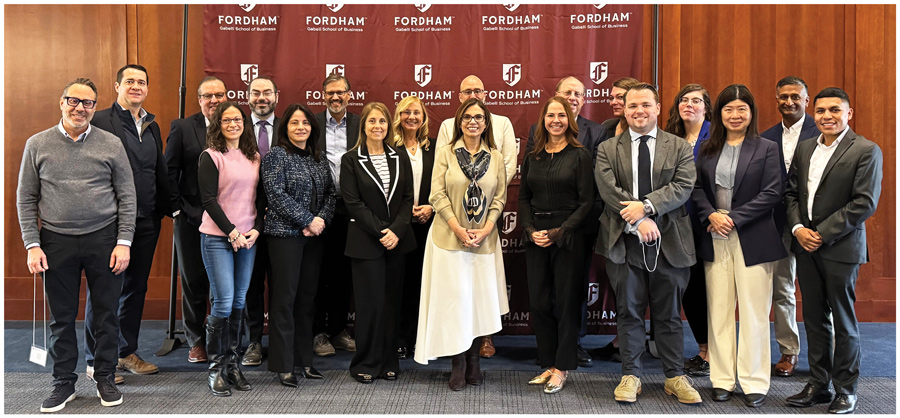
The Fordham AIBH amplifies the Gabelli School’s mission of fostering responsible business leadership that inspires innovation, community, and impact, and is a critical facet of its five-year Strategic Plan. Its foundation is focused on four pillars: Workforce Development, Upskilling, and Reskilling; Innovation, Applied Research, and Startup Development; Community Engagement and Support for Small Businesses and Nonprofits; and Ethical AI Governance and Public-Sector Innovation—all of which will contribute directly to the NYC business ecosystem.
“Fordham’s AI Business Hub reflects the University’s and the School’s commitment to preparing students from the city and the world for the global workplace of the future and for a business environment that is being transformed overnight through the use of AI,” said Lerzan Aksoy, PhD, dean, George N. Jean PhD chair, and professor of marketing, Gabelli School of Business.

Student-Run Saxbys Café Thrives at Lincoln Center Campus With Two Gabelli School Undergrads at the Helm
The cafe’s original student CEO, Aidan Engelmann, an undergraduate global finance major in his senior year at the Gabelli School, was responsible for launching the business. “Our team members were phenomenal from the start. They lived out our core values,” he said. “We grew to become one of the highest-performing Saxbys, and no one really expected that of us in our inaugural semester.”

Gabelli School And FCRH Students At Fordham London Serve On Earthshot Prize Nomination Team
Fordham London earned a place as an official Earthshot nominating organization in 2024, joining an international network that includes NGOs, investment companies, foundations, and research institutions. Through this affiliation, Fordham students are directly involved in a high-profile process, identifying and presenting nominees for consideration.
“The Earthshot Prize takes global issues and looks at them from a solutions perspective. It’s an incredible opportunity for our students to be part of that impactful work,” said Matthew Holland, senior director of Fordham London. “It is a great way of centering their experience on shared global issues while giving them a local context of how the UK is responding to these challenges.”
Improvising Leadership With Jazz at Lincoln Center:
What the Blues Can Teach Business Teams

For more than two decades, a unique collaboration between Fordham’s Gabelli School of Business and Jazz at Lincoln Center has used music to foster a creative and innovative way to approach leadership and teamwork.
The Syncopated Leadership workshop, developed by John Hollwitz, PhD, professor of psychology and rhetoric at the Gabelli School, draws a powerful parallel between the intertwining dynamics of blues and jazz ensembles and the way high-performing business teams operate. In both instances, success depends upon listening closely, adapting quickly, identifying team members’ strengths, and incorporating one another’s ideas to deliver a single, unified composition.
“About 20 years ago, we realized there were strong similarities between what happens in a really cohesive jazz or blues group and what happens in an effective business team,” Hollwitz explained.
“Especially teams that function without someone in charge, calling every shot step-by-step.”
Town+Gown:
NYC Collaboration With Gabelli School MSBA Students Turns City Data Into Real-World Insights

This experiential learning opportunity was initially led by R.P. Raghupathi, PhD, and Aditya Saharia, PhD, professors at the Gabelli School. Students tackled numerous administrative data sets provided by city agencies, analyzing them to gain insights using data-driven methods. The project scopes varied with the data sets provided and students were able to build on prior projects’ insights to apply an array of analytical techniques. Student-led research within Town+Gown aims at providing research results that can help inform future policy and practice change. As the collaboration with Town+Gown has grown in scale, it also has served to strengthen the connection between the School and NYC government.
CIO Roundtable Convenes Top Thought Leaders to Discuss Revolutionary Changes Occurring in Technology
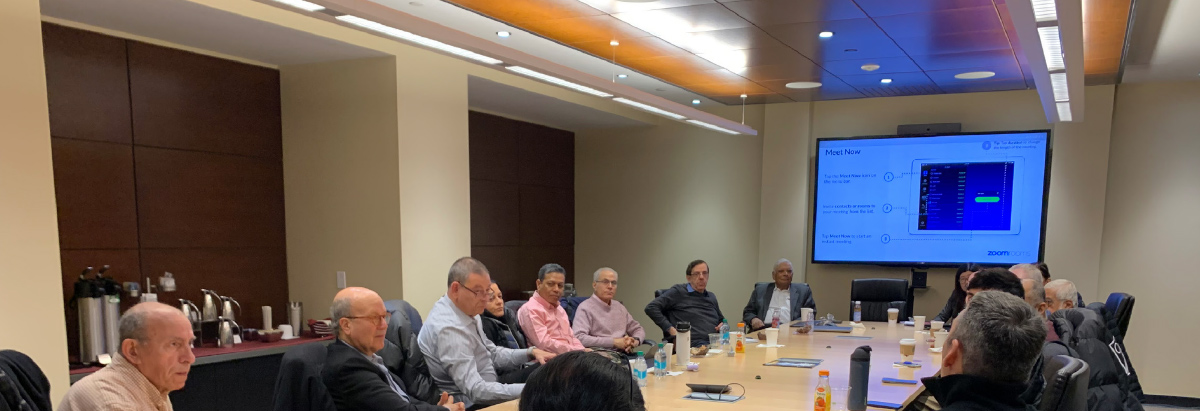
“The CIO Roundtable affords a setting in which those who are deeply involved in critical facets of technology as it relates to business, can together explore the rapidly evolving tech environment, deliberating the progress being made while understanding the social and ethical implications that come with it,” commented Saharia. “This year’s discussions have been particularly exciting as changes are happening in real time due to the lightning speed at which artificial intelligence is infiltrating everything we do. It is our goal to surface both the opportunities and obstacles that are arising and to provide the knowledge to take advantage of or to address them head on, while stimulating dialog that can lead to new breakthroughs.”

Jim Ziolkowski
Founder and CEO of buildOn Serves as Gabelli School Graduate Diploma Ceremony Speaker
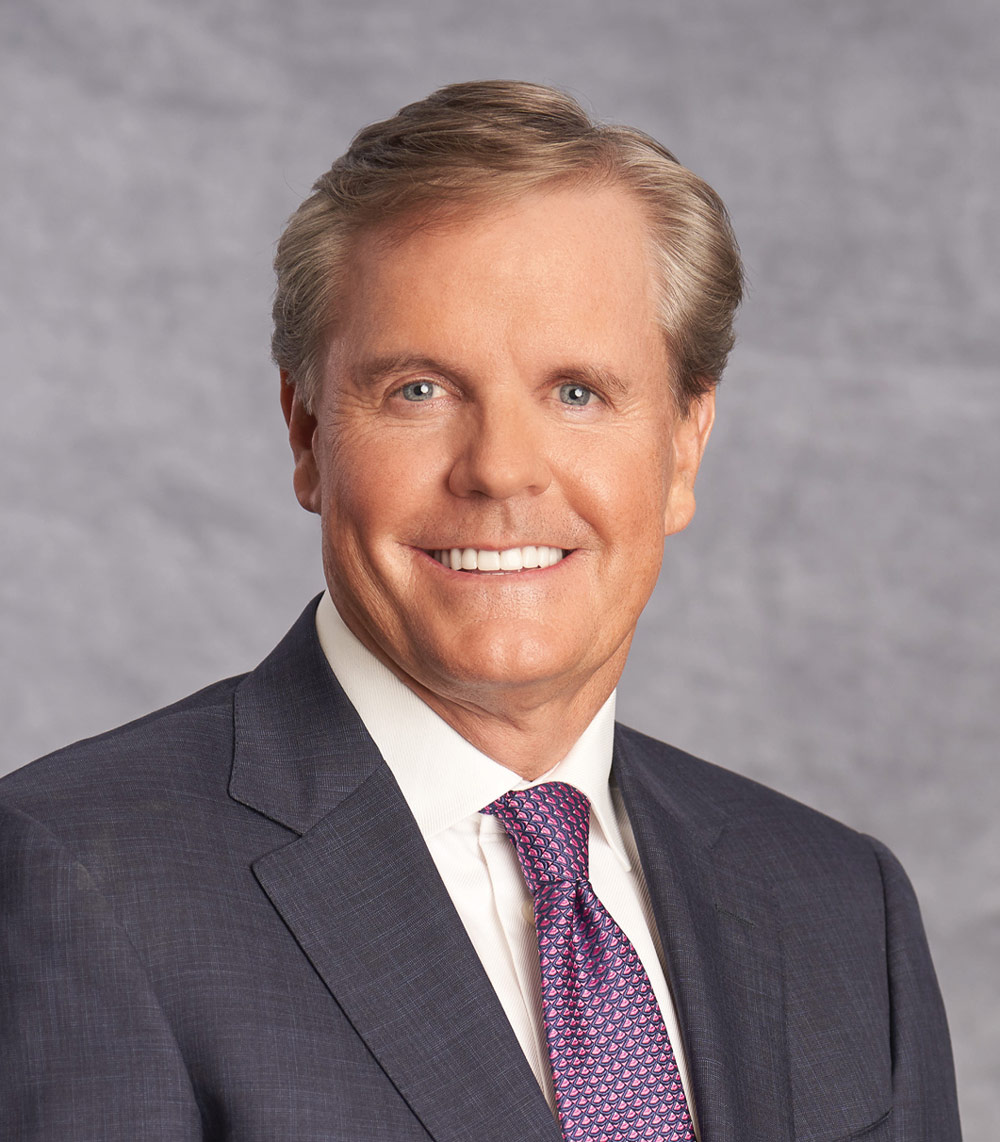
Inspired by his passion for service and education, Ziolkowski left a career in corporate finance to found the nonprofit buildOn in 1991. Since then, he has served as CEO and led the organization in breaking the cycle of poverty and illiteracy through buildOn’s Service Learning Program in the U.S. and Global School Construction Program in the world’s economically poorest countries.
To date, buildOn has mobilized hundreds of thousands of U.S. youth to contribute millions of hours of intensive service in their communities. Once students get involved in buildOn, they come to school 15 more days per year and 98% graduate on time. Globally, hundreds of thousands of parents have contributed over 5 million volunteer workdays to build more than 3,200 schools. There are now more than 400,000 children, parents, and grandparents attending these schools they helped to build. Half of the students are girls.
Ziolkowski is The New York Times bestselling author of Walk in Their Shoes and has been featured on NBC’s TODAY Show, CNN, CBS Evening News, PBS, TED, The Wall Street Journal, and NPR. He has also been endorsed by three Nobel Peace Prize laureates, including Mother Teresa, the 14th Dalai Lama, and former President Barack Obama. Ziolkowski received a Doctorate in Humane Letters, honoris causa, from St. John’s University, where he delivered the commencement speech for the 2024 graduating class.

Daniel Troise
Student Advisory Council
Graduate Diploma Ceremony Speaker
“The Gabelli School offered me a structured path to curiosity, where community and conversation were just as important as the coursework,” he noted.
Troise already had a well-established global career in communications and external relations when he enrolled in the MBA program.

Nellie Podokshik
Gabelli School of Business
Raised in Brooklyn, Podokshik trained from an early age for a professional ballet career, completing much of her schooling online while pursuing this demanding path. By the time she was contemplating life after high school, she was performing with elite ballet companies and was expecting to accelerate her rise in the arts. Then came the COVID-19 pandemic, which abruptly changed this carefully planned trajectory.
As theaters closed and ballet companies struggled, faltering due to weakened business infrastructure, Podokshik witnessed firsthand, the widening gap between artistic excellence, creative potential, and the sound business acumen and solid management practices required to sustain arts-related institutions in good times and in bad. “I decided that I wanted to fill that gap and become a leader in a creative field who understands both artistry and performance, as well as the business knowledge that is needed for these organizations to thrive,” she noted.
The Carefully Calculated Job

From the start, Pantoja approached the MBA as both a technical and leadership platform. Outside the classroom, he served as vice president of the Investment Banking, Private Equity, and Venture Capital Club and founded the Dean’s Advisory Council, both experiences that expanded his network and deepened his engagement with the Gabelli School community. With mentorship from Dean Lerzan Aksoy, PhD, and other faculty members, he refined not only his finance skills, but also his ability to communicate his value with clarity and confidence.
Salute to the Full-Time MBA Class of 2023

Josefina Israel
Fixed Operations Manager, Nissan North America
Israel was selected as a Poets&Quants MBA to Watch in 2023 during her studies at the Gabelli School. She completed a sales and marketing internship at Nissan North America, eventually joining the company as a full-time marketing analyst, and has been promoted twice since.
Israel believes that Fordham’s collaborative culture provided a tremendous advantage. “I learned so much from my classmates,” she explained, citing her cohort’s capstone experience in London as being particularly impactful. “It was an opportunity for us to work as colleagues through real business challenges.”
Leadership and Management: Accelerating Workforce Transformation Through Technology and the Human Edge
The fields of leadership and management have seen myriad changes over the past 50 years. Sparked by shifts in organizational structuring, societal values, and the dynamics of an increasingly global workforce, these adaptions have greatly impacted the way we do business. Yet they have also been more measured in comparison to the rapid and consequential sea change currently taking place across industries.
The Rapid Pace of Change
Overnight, generative AI and digital technologies have transformed the very nature of work and have made once-critical facets of the job market obsolete. In addition to improving the way we work by automating tasks, boosting performance and outcomes, and advancing data-driven decision-making capabilities, these changes are also accelerating the need to learn new skills in real time.
While the influence of AI on the job market is already measurable, the pace of this workforce transformation is predicted to accelerate, with half of today’s work activities potentially being automated between 2030 and 2060, according to McKinsey and Company. The global management consulting firm also reports that AI’s influence on productivity and innovation will supercharge the global economy, contributing up to an estimated $13 trillion by 2030.
As these exciting, but sometimes unnerving advances continue to unfold, they will forever change the way we manage and lead people and organizations. To be successful in navigating this new landscape—taking advantage of rapid progress while ensuring a level of stability and integrity—leaders and managers must be well-equipped. They will need to be open and willing to build the new skill sets that will address the changes ahead, while fostering a human-centered culture and cohesive work environment that inspires teamwork, collaboration, innovation, and personal and professional growth.
Educating
Managers
to Lead and
Succeed
hat key skills do successful leaders need today? According to the World Economic Forum’s 2025 Future of Jobs Report, analytical thinking is the most sought-after core skill among today’s employers followed by resilience, flexibility, agility, and social influence. Technical skills, including AI, big data, and technology literacy top the list of the fastest-growing skills, and creative thinking, curiosity, and lifelong learning will continue to rise between 2025 and 2030, the report states.
The Gabelli School’s 30-credit MS in Management program hones these skills and much more. This classic business management degree program is anchored in accounting, analytics, finance, operations, and strategy, with a unique focus on humanistic management and global leadership.
“The fundamental business knowledge and the leadership skills this program develops opens the doors for our students to step into the business world and succeed,” said Professor Dongli Zhang, PhD, director of the MS in Management program. “They build strong analytical skills, logical thinking, and a holistic view of business,” she added.
Research on Firms Having Collaborative Relationships With Competing Companies Offers Revealing New Insights
Asgari, who is an associate professor of strategy and technology management, the Grose Family Endowed Chair in Business, and associate director of the Global Healthcare Innovation Management Center at the Gabelli School, explains that alliance partner demands for intellectual firewalls can lead to disconnectedness in a focal firm’s internal collaborative network, inhibiting the recombination of ideas and stifling innovation. In other words, measures designed to prevent knowledge leakage across firms can unintentionally undermine knowledge recombination within firms.
“Firms may like the idea that their alliance partners are competitors, because it gives them more bargaining power,” he asserted. “But they should be aware that if they are forced to erect these walls, it will ultimately undermine their capabilities in creating new value.”


Going Private Transactions:
Structures and Legal Implications

A going private transaction is when the publicly held shares of a company are acquired by a controlling shareholder, management, or a private equity firm, and the company is delisted from stock exchanges and terminates its registration with the SEC. In this case, the former publicly held company decided that there would be some advantages to private ownership, perhaps in the case of a struggling organization to make operational changes without glaring public scrutiny, or to free a company from the costs of periodic public reporting. Many well-known businesses have gone private in recent years, including Continental Resources, Inc. in 2022 and Nordstrom, Inc. in 2025.
“If you’re a publicly traded company, you’ve got a lot of pressures on you from investors to meet earnings estimates,” explained author Brent J. Horton, JD, associate professor and area chair of Law and Ethics at the Gabelli School. “It puts a lot of constraints on various directions that you can take the company, different innovations that you can implement.
So a lot of companies, especially if they want to go in a direction that may cause shareholder pushback, go private so that they don’t have to worry about that.” That was the case with Dell Computers, which is one of several case studies included in the book.
FACULTY PROMOTIONS
Marketing
Ahir Gopaldas is recognized for his influential and interdisciplinary research in marketing. His work demonstrates intellectual leadership and meaningful engagement with the broader academic community, strengthening both the Marketing Area and the School’s research reputation.

Accounting and Taxation
Hye Seung (Grace) Lee’s promotion reflects outstanding scholarship, dedicated teaching, and meaningful service to Fordham University. Her continued leadership in research and commitment to student learning exemplify the best of the Accounting and Taxation Area.

Kelly Ulto ’88
Clinical Professor of Accounting
At the Gabelli School, Ulto has been a dedicated member of the faculty as a clinical professor for more than two decades, and she is also the director of the MS in Accounting and MS in Taxation programs.
While she always planned to become an accountant, Ulto’s entry into higher education was serendipitous. “I went to an alumni event and someone said, ‘We’re looking for an instructor who can teach advanced accounting. Would you want to do it at night as an adjunct?’” she reflected. So, she returned to the Gabelli School of Business, where she had earned her undergraduate degree in accounting years before.
Masthead
Lerzan Aksoy, Ph.D.
Dean, Gabelli School of Business
Executive Editor
Paola Curcio-Kleinman
Managing Editor
Claire Curry
Paola Curcio-Kleinman
Claire Curry
Michelle Livingston
Kimberly Volpe-Casalino
Fordham University President
Tania Tetlow
Provost
Dennis C. Jacobs, Ph.D.
Fordham Business welcomes your comments and suggestions. Email gsbnews@fordham.edu.
Does Fordham have your correct contact information? If not, please contact the Office of Alumni Relations at 800-314-ALUM or alumnioffice@fordham.edu.
Or update your profile at forever.fordham.edu. Opinions expressed in this publication may not necessarily reflect those of the Fordham University faculty or administration. © 2026, Fordham University Gabelli School of Business

QuantVision 2026
On March 19 and 20, 2026, Fordham’s Gabelli School of Business—in collaboration with Rebellion Research—hosted QuantVision, a conference attended by students, academics, and industry executives from around the world. The conference featured panel discussions with a roster of renowned international experts on emerging topics including, The Future of Machine Learning in Quantitative Finance, Capturing Alpha in 2026 Markets and ETF’s, Entering the Age of Cognitive Markets, and Alternative Data’s Next Frontier. Industry leaders shared their insights on a field that is changing overnight—from tensions between Bitcoin’s brand dominance and the larger crypto ecosystem to the development of data structure in the age of AI. Workshops provided an even more granular opportunity to dive deep into the world of quantitative analysis. Carefully curated and spontaneous networking opportunities afforded the chance to meet and mingle with leading researchers and executives who are driving disruption in this rapidly evolving industry.